‘the mind is embodied… not just embrained’. – Antonio Damasio
This experimental work reflects the multiple universes that the act of reading can conjure whilst we remain in the one that we recognise the most. It consists of a participatory ‘reading/walking’ event exploring the interconnectedness of body and mind. The perception of moving through multiple universes at the same time, one a shared physical space, others more temporal and virtual, accessed via an experience of parallel durations, reverie and affect. It is an evocation of the spirit of the flaneur, psychogeography and the situationist dérive, the experience of reading conjuring up worlds within worlds, amplified here through mobility and the shared experience.
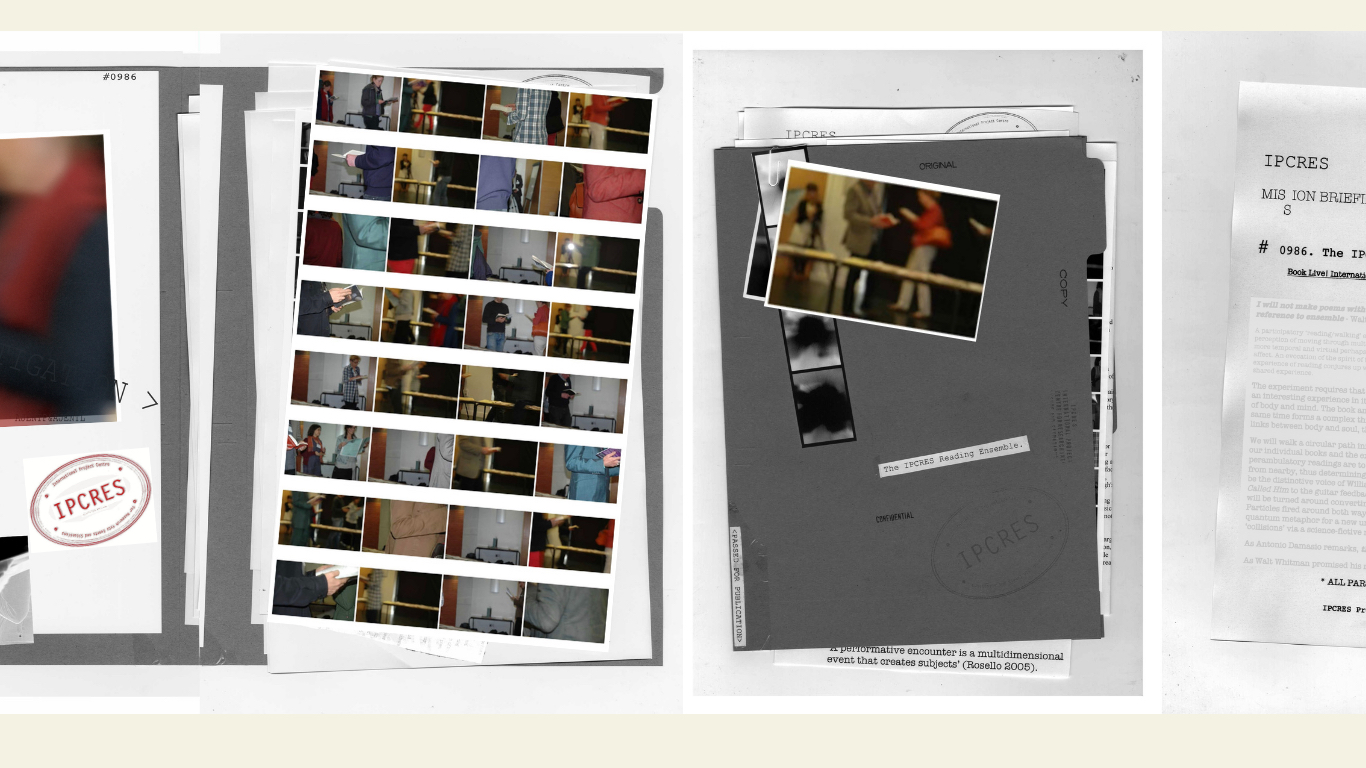
The Reading Ensemble requires that participants set off walking and reading at the same time, an interesting experience in its own right. They walk in a circular manner, the route being as large as the space dictates. This simple act of walking and reading whilst traversing a set circular route provides the hypnotic conditions for reverie, a transportation into daydream played out in parallel to the physical space of the event. Walking and reading at the same time forms a complex threshold between worlds, making manifest the intrinsic links between body and soul, the thin membrane between universes. The book as physical object is what Anne-Francoise Schmidt has called an ‘integrative object’, in that it holds multiple dimensions blurring the boundaries between subject and object. As made more obvious in our Conversion of Essence into Series work all objects, material and immaterial, potentially have these properties.
The design of the experiment converts participants into particles in a metaphorical ‘Large Hadron Collider’, setting them in motion around a circular pathway. At some stage some of them are turned around to walk the other way (analogous to the scientific experiment) in order to see if we can produce collisions. These potential collisions are recorded photographically at two points on the route in order to intuit the origins of each potential universe. Of course this is a thought experiment, but this method gives us the chance to explore the possibilities of non-decisional photography, as the shutters are fired off randomly by IPCRES personnel when sensing a potential impact. Perhaps this constitutes an instance of non-photography or a photo-fiction/ theoretical installation, as instigated via the thought of Francois Laruelle.

Walking and reading in a circular movement becomes hypnotic, settling participants into a series of rhythms, both internal and external as they begin to sense their envelopment. A perception of moving through two universes at the same time, one a shared physical space, one a more temporal personal space of reverie perhaps. These perambulatory readings are to be accompanied by a ‘soundscape’ drifting in loudly from nearby, thus producing another ‘universe’ whilst also determining the duration of the event. In past iterations of this event the soundscape has consisted of the distinctive voice of William S Burroughs reading his short story The Priest they Called Him to the guitar feedback of Kurt Cobain. As mentioned random participants will be turned around to travel in the opposite direction to see if collisions can be generated and measured/observed, each collision a quantum metaphor for a new universe.
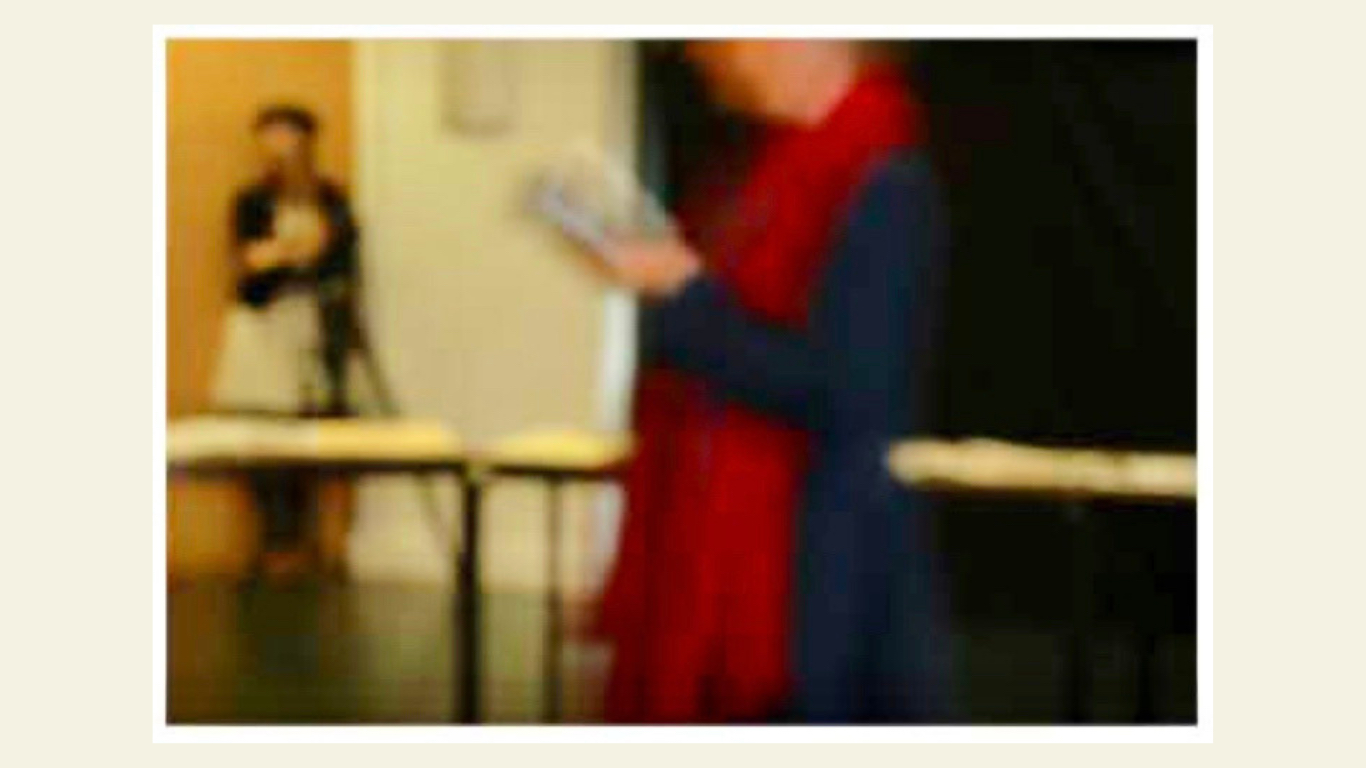
Participants will bring a book and together they will produce an interactive social poem, consisting of a combination of their embodied movement and their imaginary interior worlds, evoking the daydreaming women in Johannes Vermeer’s paintings. The book and the experience of reading, conjuring up worlds within worlds is highlighted and amplified through mobility.
As Walt Whitman said: Your very flesh shall be a great poem.
This project has been performed with student groups and participants at the Book Live! International Symposium, South Bank University, London.
If you would like a Reading Ensemble for your institution, witness the experiment in action and partake in a new pedagogy of ideas, please get in touch with IPCRES.


Leave a Reply