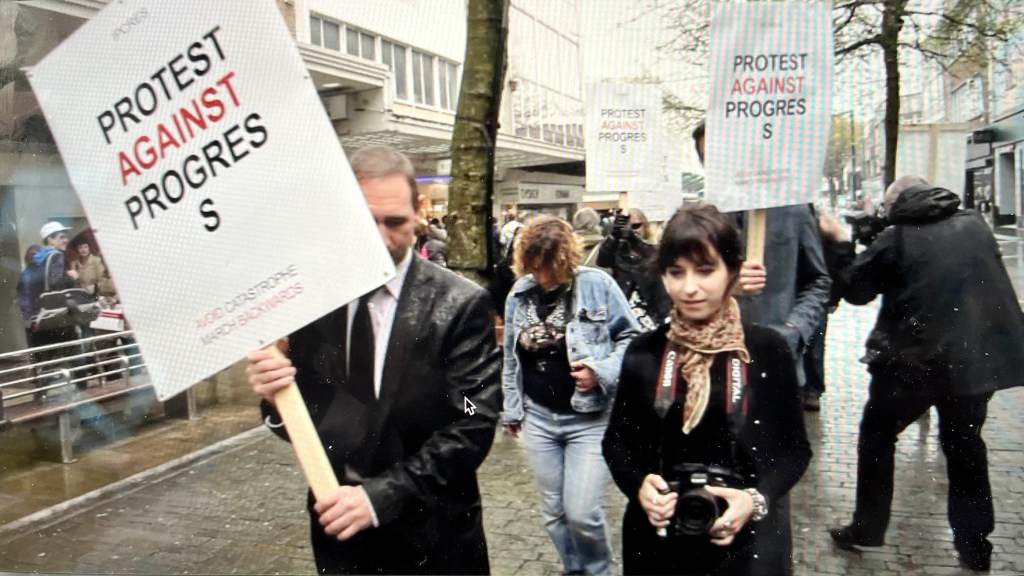
This is a playful participatory artwork that picks up on the general dissatisfaction of people with the present conditions in which we live. This can be anything from the personal to the political. The phrase ‘one step forward, two steps back‘ is a familiar phrase used in many situations, meaning that just when you think progress is being made you experience events that seemingly put you further back than ever. Arguably this feeling is one that is universal to our everyday existence and one that has probably been experienced across the generations.
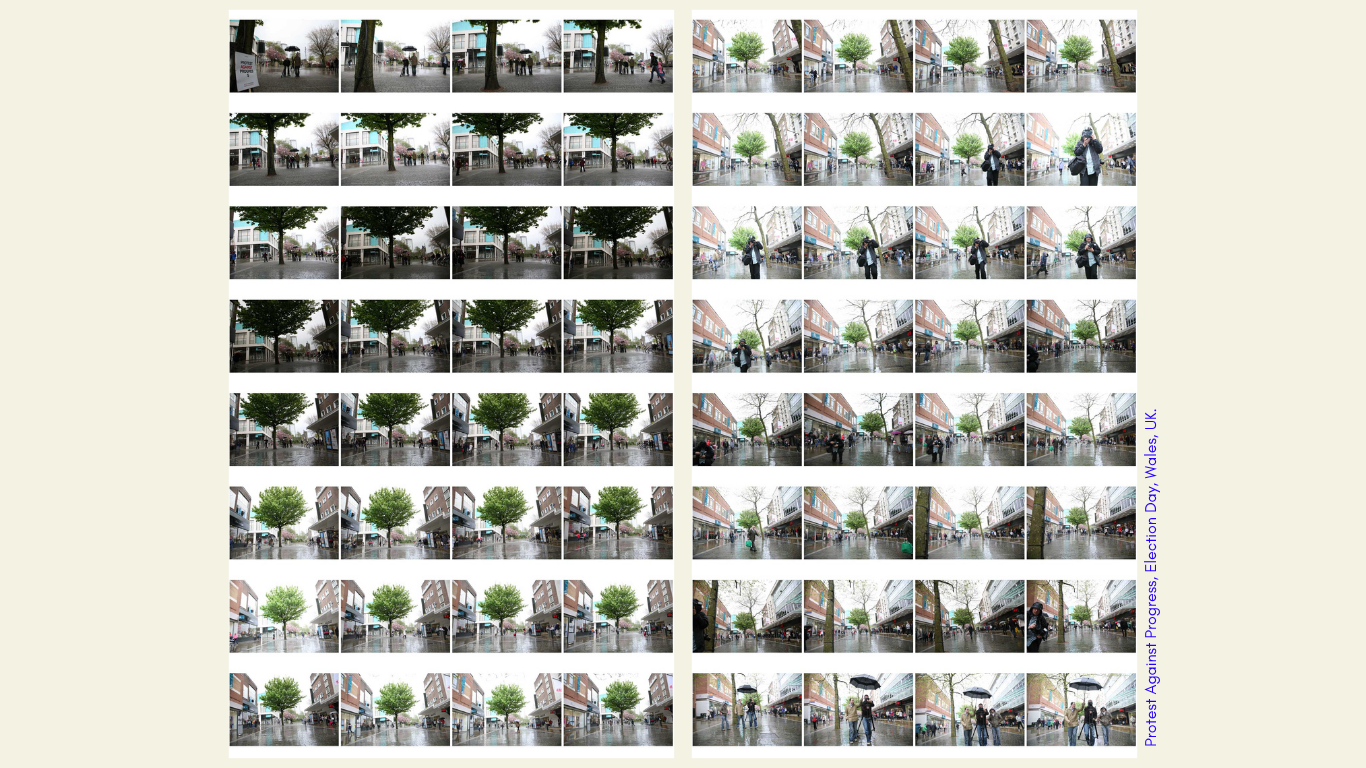
This project is a non-representational performative action concerned with a light-hearted protest against the concept of progress, (more of the same!) or in most people’s experience just change. To date it has been staged twice, once on a national election day in Wales UK with a second iteration at the Copenhagen Business School (CBS) in Denmark (The 4th International Deleuze Studies Conference).
Philosophically the concept stems from the C20th critic Walter Benjamin’s conflation of progress with catastrophe, and is best expressed in his final work On the Concept of History (1940). Here he rejects the linear forward movement of history with its intimations of an increasingly improving future. Instead he equates the continued status quo (the continued emphasis of this world view) with catastrophe. The continued feeling that things are not getting any better and it is always us, the people, who suffer.
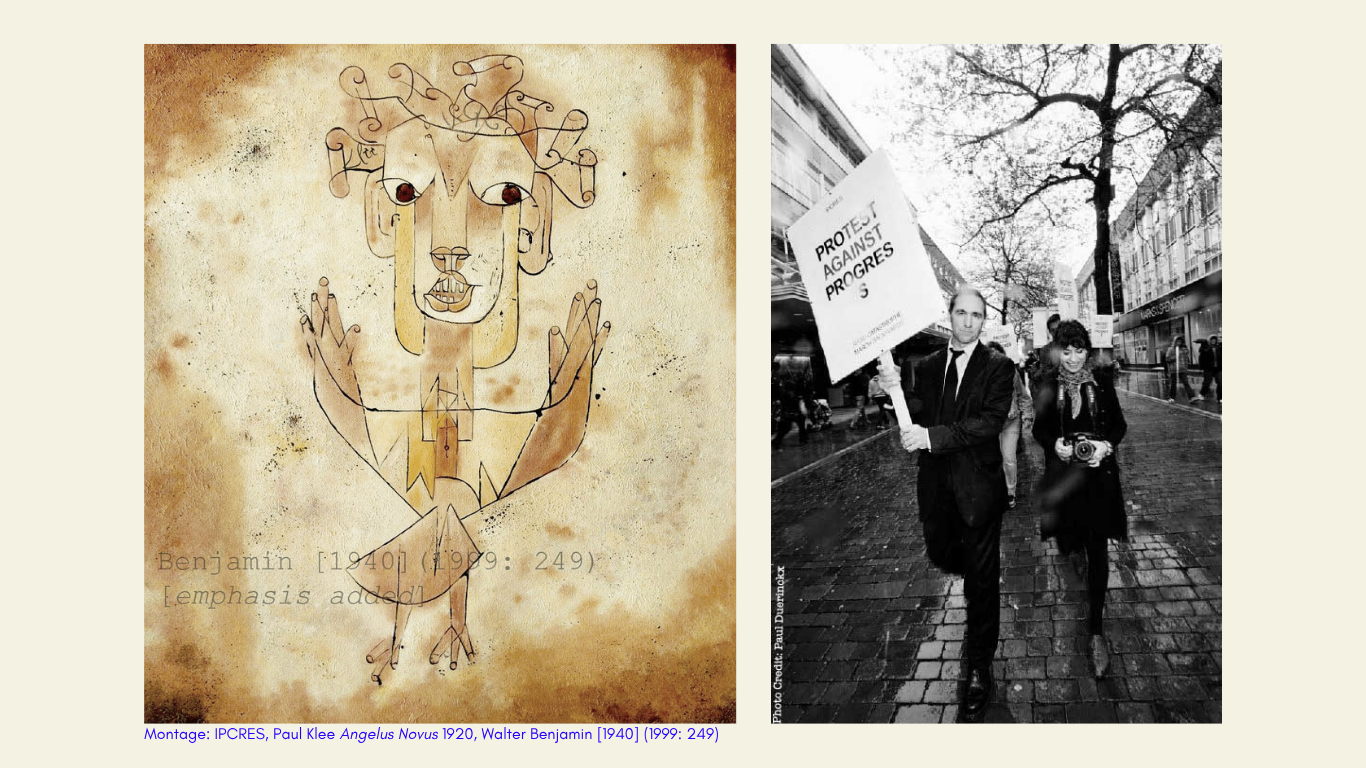
Utilising Paul Klee’s painting Angelus Novus (1920), Benjamin produced an image of the Angel of History being blown backwards by the storm of progress with a growing mountain of debris at its feet in which they are powerless to intervene. This concept of progress is intrinsically linked today to the seemingly inevitable ‘march’ of advanced capitalism and technological expansion, which just as with systems of societal organisation in previous centuries, marginalises the majority of the people, promotes inequality and leaves us living in a state of permanent disaster. Even more real at present with the looming ecological disaster.
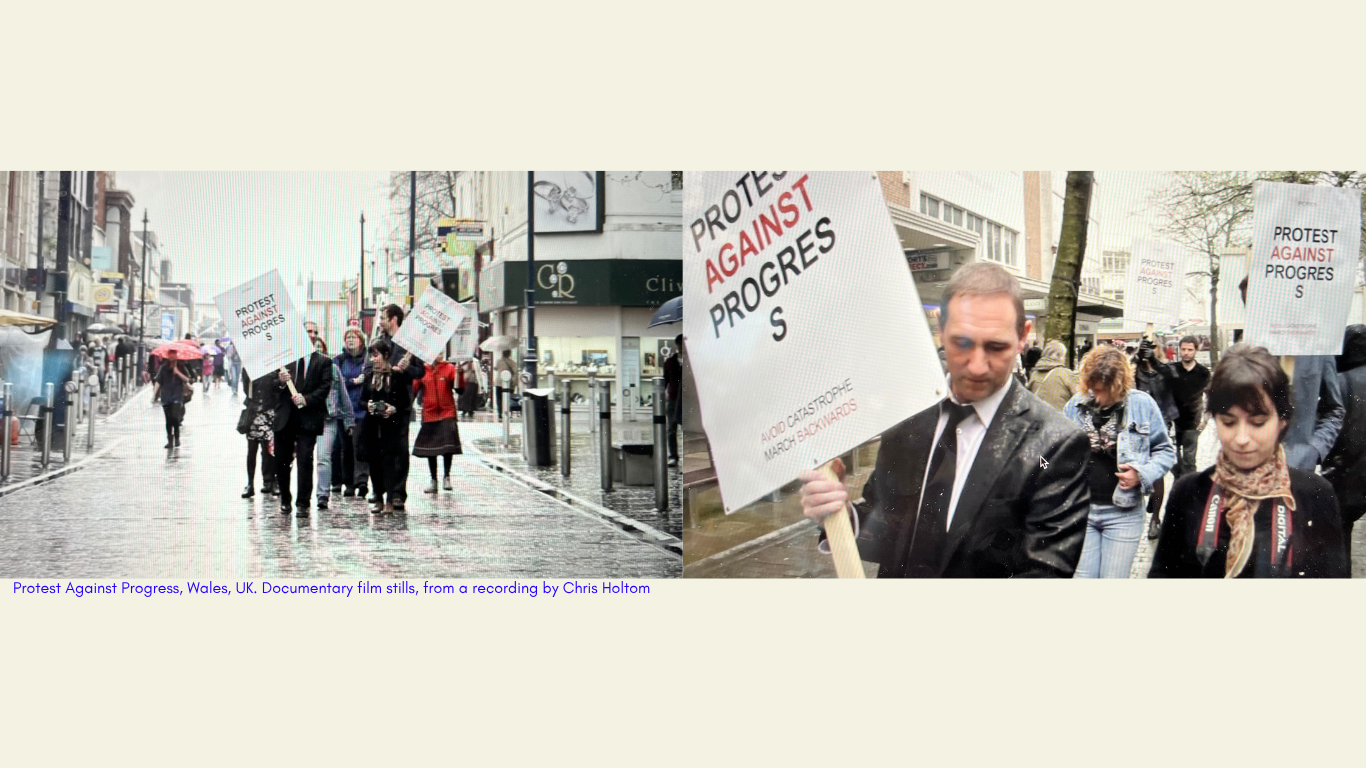
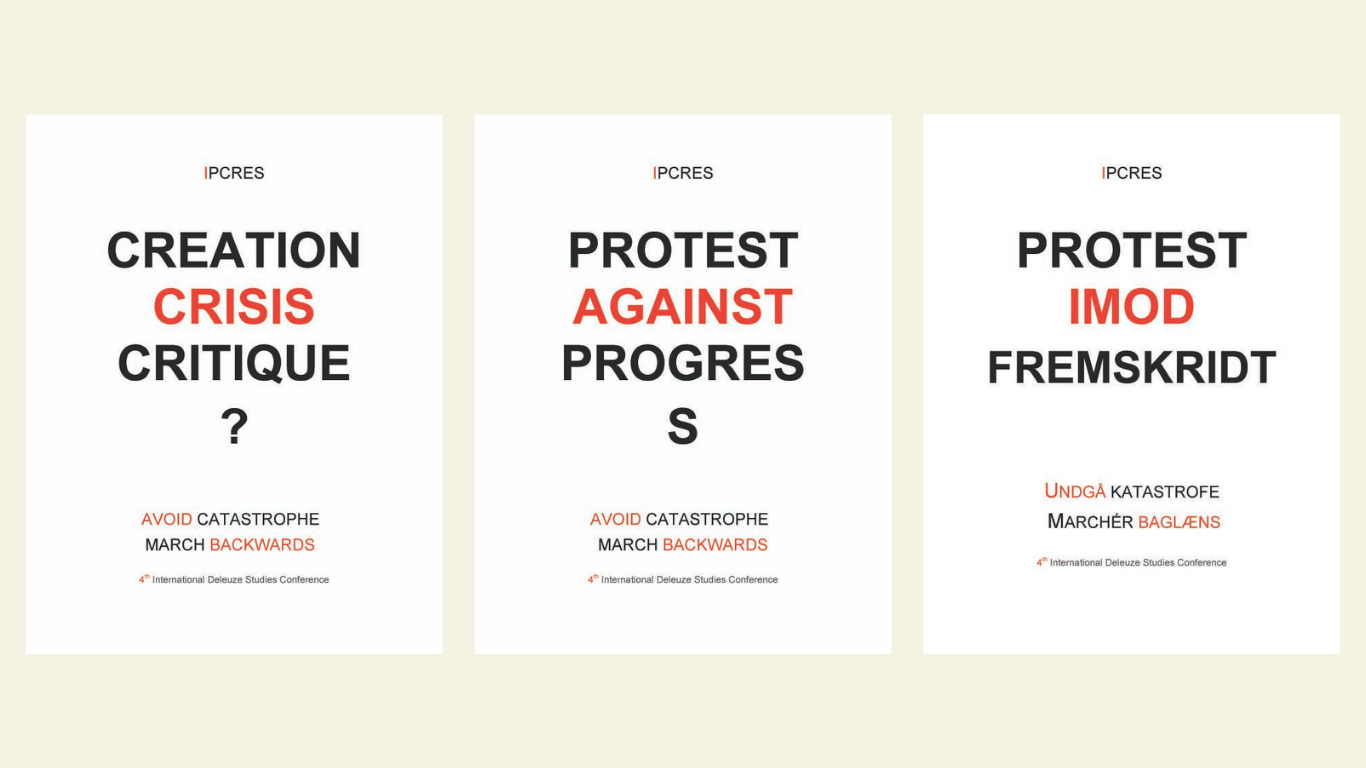
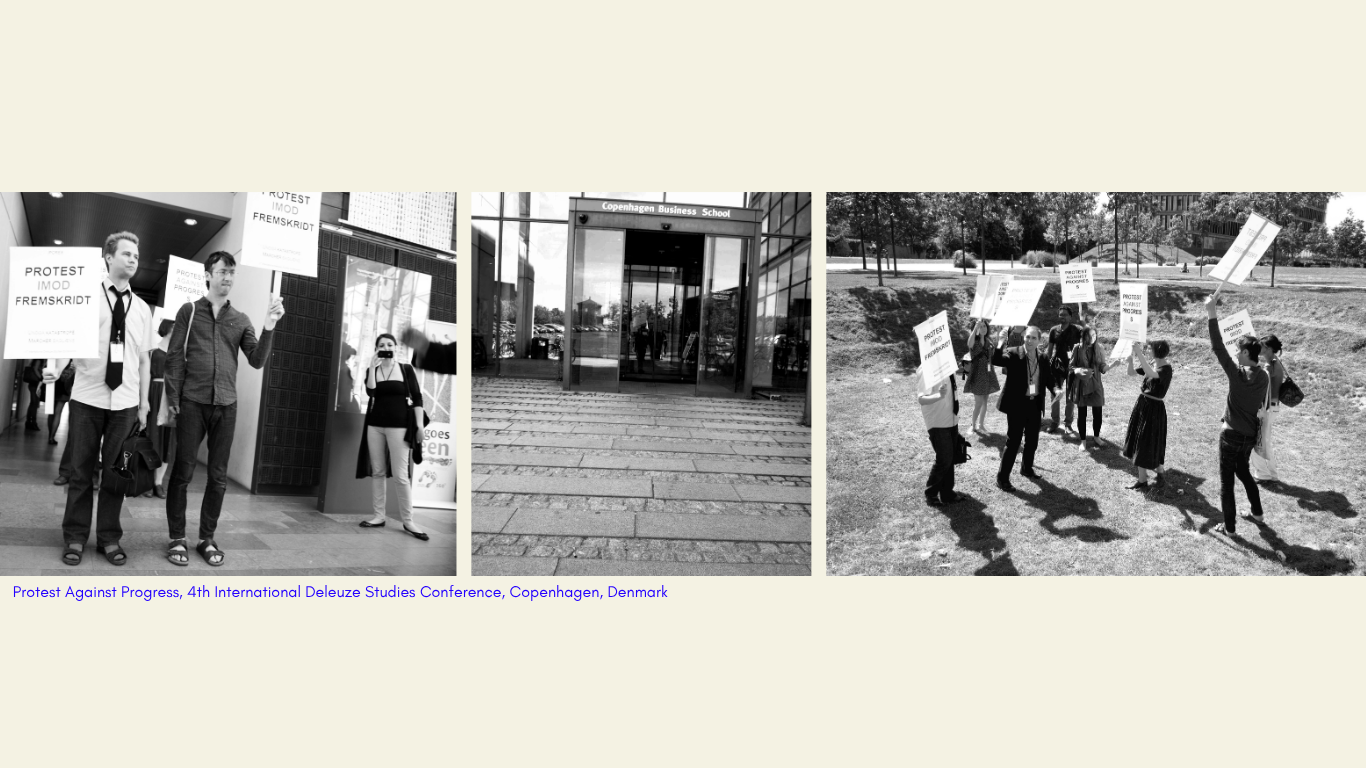
In Copenhagen our expression was aimed at what many perceive as voracious business practices, managerial dogmas based on data and inflexible political systems. The participants came from the philosophy conference which was hosted by the Business School, and consisted of delegates, philosophers, educators and students (we add our appreciation here for CBS and their ability to absorb the ironies in our work with good humour). And so an assembled group convened at an agreed time and place in the city of Copenhagen for the second and larger of the works. The assembly held IPCRES placards sporting the words ‘Protest Imod Fremskridt’, ‘Protest Against Progress’, ‘Creation Crisis Critique’, and ‘Avoid Catastrophe March Backwards’.
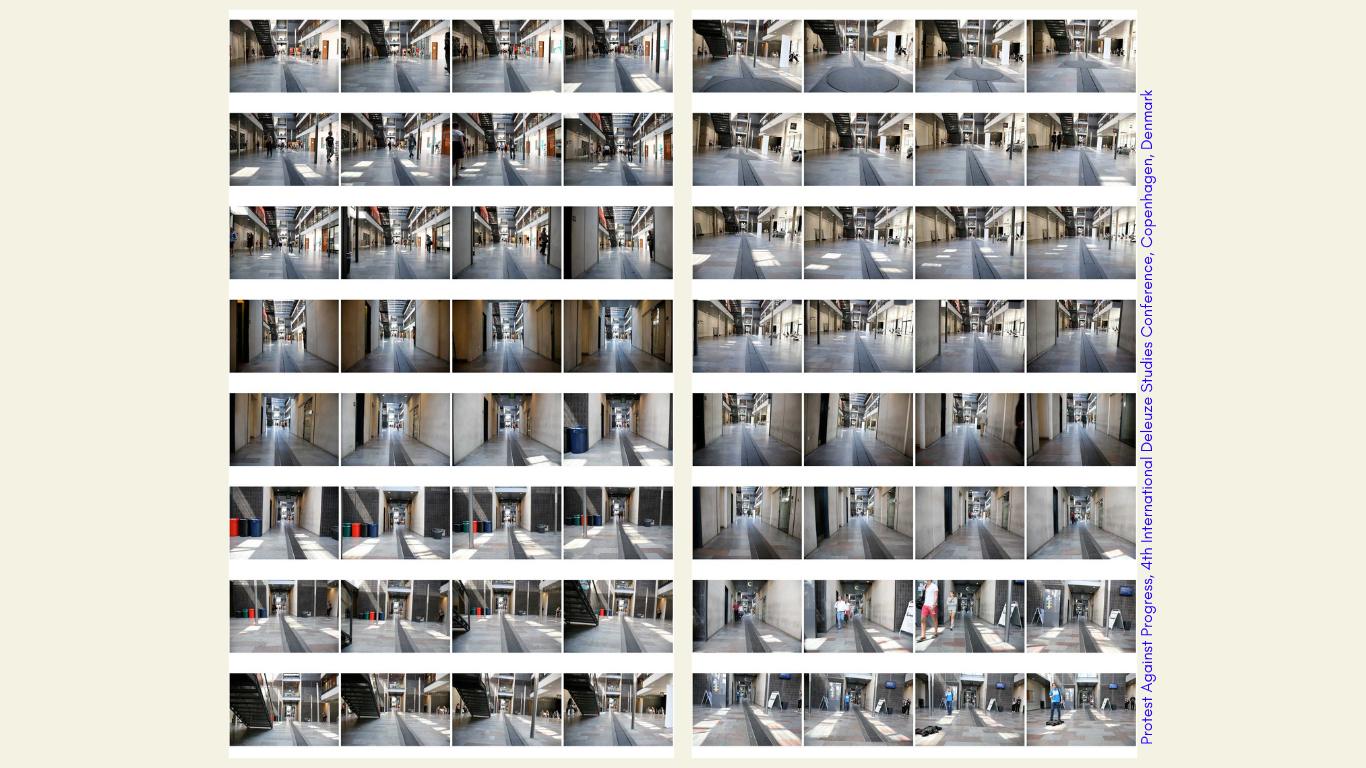
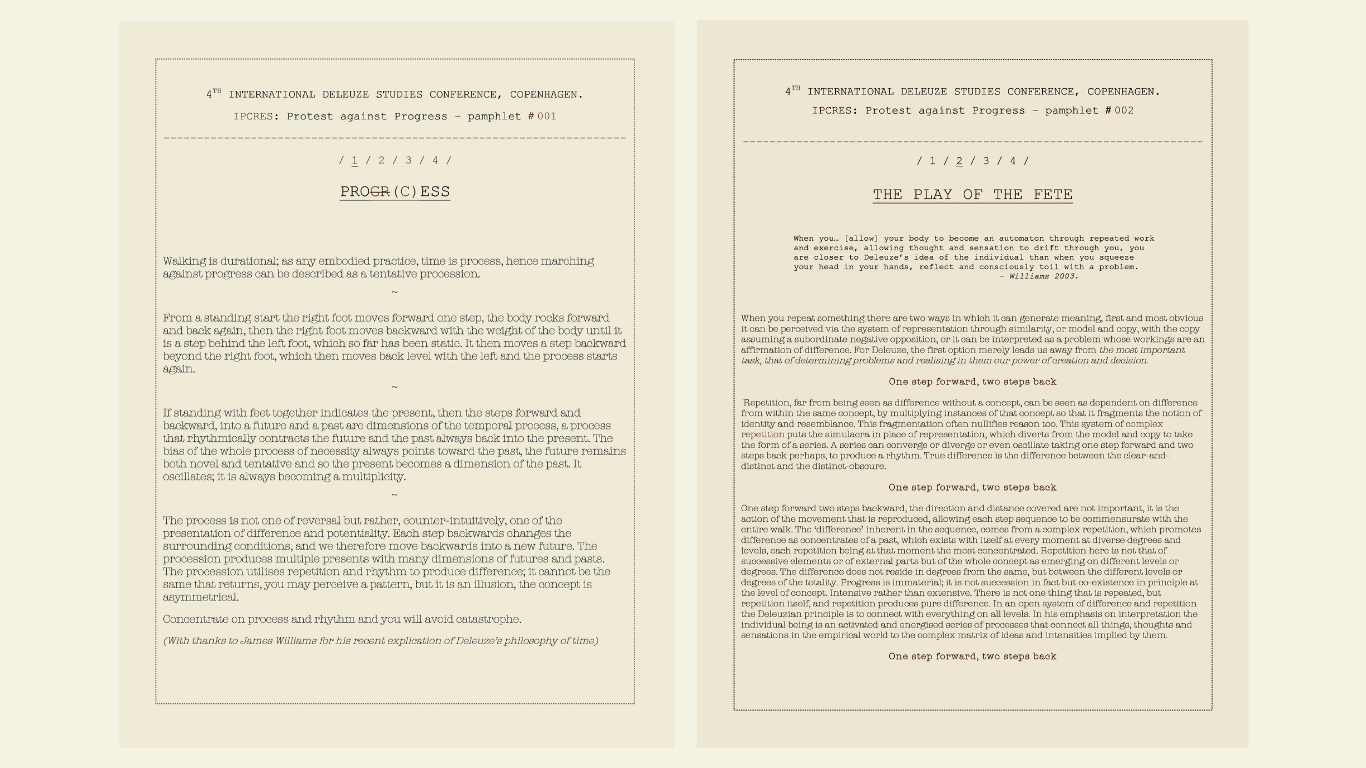
The march began with the participants in two columns facing backwards in terms of their direction of travel. On a given beat they took one step forward together, followed by two steps back. This continued rhythmically so that the ensemble progress slowly backwards until it arrives at its destination. In the case of the Copenhagen Business School this was a straight line backwards through the building from the main lecture hall , out of the main doors, across the lawns to a sunken grass amphitheatre. The movement gave the impression of a slow moving animal/machine lurching forward then backward, receding back through space. To document the event Dr Laura Jenkins at the ‘head’ of the march with a camera around her neck, released the shutter every third step thereby documenting a slowly receding spatial view, reminiscent of Vito Acconci’s work Blinks (1969).
As a critique of society this project is part of IPCRES’s programme of qualitative easing. In an increasingly information obsessed, homogenous and quantifiable society, where everything is described and measured and nothing experienced beyond the audit, we deem it desirable to inject enigmatic qualitative lived ‘moments’ into the urban space. Our process involves incursions into everyday life providing a playful space where people can think and consider the world from a new perspective. An antidote to a quantitatively bland, increasingly homogenised world where lived experience and human creativity seem to be valued less and less.
We consider the present day to consist of a qualitative recession masked by a quantitative boom. Qualitative easing allows people to encounter strangeness on the streets for no cost and little reason. We hope that our participatory public works help increase our ability to encounter the world rather than merely recognise it and fall in line. Meaning is as deep or as shallow as you wish because it is function that is prioritised, and our only aim is the generation of stories, smiles of acknowledgment, and an appreciation of the moment you find yourself in.
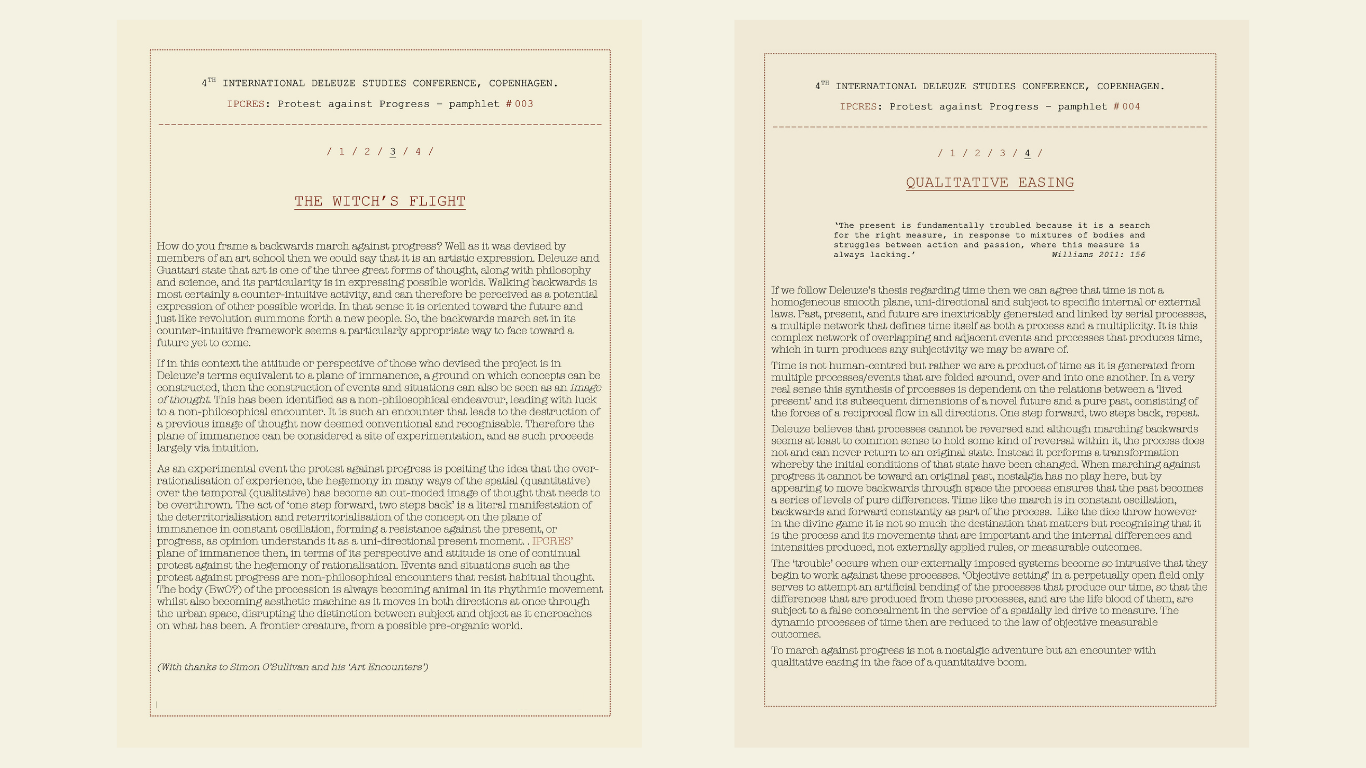
In the face of a perceived plurality of crises – ‘financial, ecological, political, existential, aesthetic’ IPCRES is taking a stand through this artwork against all those things, both small and large that are seemingly foisted upon us. Particularly perhaps the insidious infliction of neo-liberal managerial cultures and their voracious audit culture that floods everyday life with ‘data’. IPCRES considers that data can often be the very thing that stops us from moving forward. Data stifles creativity, numbing the mind and leading to an impression that our freedom to think is constrained, and maybe for every step forward we take we seem to be falling back a further two steps.
If you have a situation that would benefit from our Protest against Progress work please get in touch with IPCRES.


Leave a Reply